Skip to contents

Country names never line up across data sources. "US", "U.S.", "United States", "United States of America" and "America" are the same country, but a naïve left_join() treats them as five. countryatlas kills that pain by making ISO codes the universal join key and handing you a single, ready-to-map tibble that already stitches together three otherwise disjoint worlds:

  • ggplot2::map_data("world") (or Natural Earth sf) — where countries are,
  • WDIwhat is true about them (World Bank indicators),
  • countrycode — the Rosetta stone (ISO codes, continents, regions) that makes the join possible.

The happy path is one call: world_data(2020). Everything else is opt-in.

Installation

# install.packages("devtools")
devtools::install_github("PursuitOfDataScience/countryatlas")

The base install is light. Heavy spatial extras (sf, rnaturalearth, cartogram, biscale, geofacet, gganimate, leaflet, …) live in Suggests and are only needed for the features that use them.

One call to a map-ready tibble

data_2020 <- world_data(2020)
data_2020
#> # A tibble: 99,338 × 13
#>     long   lat group order subregion iso3c iso2c country continent region income
#>    <dbl> <dbl> <dbl> <int> <chr>     <chr> <chr> <chr>   <chr>     <chr>  <fct> 
#>  1 -69.9  12.5     1     1 <NA>      ABW   AW    Aruba   Americas  Latin… High …
#>  2 -69.9  12.4     1     2 <NA>      ABW   AW    Aruba   Americas  Latin… High …
#>  3 -69.9  12.4     1     3 <NA>      ABW   AW    Aruba   Americas  Latin… High …
#>  4 -70.0  12.5     1     4 <NA>      ABW   AW    Aruba   Americas  Latin… High …
#>  5 -70.1  12.5     1     5 <NA>      ABW   AW    Aruba   Americas  Latin… High …
#>  6 -70.1  12.6     1     6 <NA>      ABW   AW    Aruba   Americas  Latin… High …
#>  7 -70.0  12.6     1     7 <NA>      ABW   AW    Aruba   Americas  Latin… High …
#>  8 -70.0  12.6     1     8 <NA>      ABW   AW    Aruba   Americas  Latin… High …
#>  9 -69.9  12.5     1     9 <NA>      ABW   AW    Aruba   Americas  Latin… High …
#> 10 -69.9  12.5     1    10 <NA>      ABW   AW    Aruba   Americas  Latin… High …
#> # ℹ 99,328 more rows
#> # ℹ 2 more variables: gdp_per_capita <dbl>, gdp_per_capita_2015 <dbl>

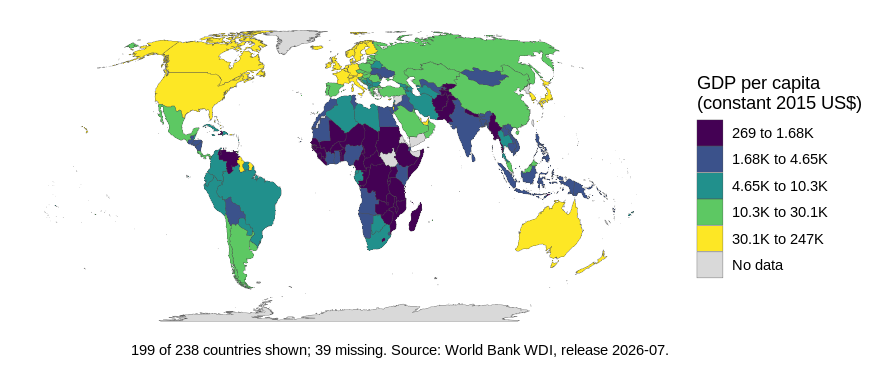
world_data() returns the map geometry, the requested World Bank indicator(s), income and continent — already keyed on iso3c/iso2c. Draw a choropleth with the built-in world_map() helper (no more hand-rolled geom_polygon() boilerplate):

world_map(data_2020, gdp_per_capita, style = "quantile",
          title = "GDP per capita, 2020")

world_map(data_2020, income, style = "categorical")

Any indicator, any year span

Pass one or many WDI codes with friendly names, or a year range to get a panel:

country_data(2020, c(life_exp = "SP.DYN.LE00.IN", co2 = "EN.GHG.CO2.PC.CE.AR5")) |>
  head()
#> # A tibble: 6 × 8
#>   iso3c iso2c country        continent region           income life_exp      co2
#>   <chr> <chr> <chr>          <chr>     <chr>            <fct>     <dbl>    <dbl>
#> 1 AFG   AF    Afghanistan    Asia      Middle East, No… Low i…     61.5  0.311  
#> 2 ALB   AL    Albania        Europe    Europe & Centra… Upper…     77.8  1.81   
#> 3 DZA   DZ    Algeria        Africa    Middle East, No… Upper…     73.3  3.90   
#> 4 ASM   AS    American Samoa Oceania   East Asia & Pac… High …     72.7  0.00201
#> 5 AND   AD    Andorra        Europe    Europe & Centra… High …     79.4 NA      
#> 6 AGO   AO    Angola         Africa    Sub-Saharan Afr… Lower…     63.1  0.614

Use the bundled common_indicators catalogue so you never memorise a code:

head(common_indicators)
#> # A tibble: 6 × 3
#>   name                   code           description                       
#>   <chr>                  <chr>          <chr>                             
#> 1 population             SP.POP.TOTL    Population, total                 
#> 2 gdp                    NY.GDP.MKTP.CD GDP (current US$)                 
#> 3 gdp_constant           NY.GDP.MKTP.KD GDP (constant 2015 US$)           
#> 4 gdp_per_capita         NY.GDP.PCAP.KD GDP per capita (constant 2015 US$)
#> 5 gdp_per_capita_current NY.GDP.PCAP.CD GDP per capita (current US$)      
#> 6 gni_per_capita         NY.GNP.PCAP.CD GNI per capita (current US$)

Get your own data onto a map

This is the headline use case. You have a frame keyed on messy country names — join_world() standardises it and attaches geometry in one call:

my_data <- data.frame(
  nation = c("U.S.", "S. Korea", "Czechia", "Kosovo", "Cote d'Ivoire"),
  score  = c(10, 8, 6, 4, 7)
)

my_data |>
  join_world(nation, warn = FALSE) |>
  world_map(score, title = "My data, joined on the ISO spine")

Or reconcile two messy tables directly — "Czech Republic" vs "Czechia", "South Korea" vs "Korea, Rep." just work:

a <- data.frame(country = c("Czechia", "South Korea"), gdp = c(1, 2))
b <- data.frame(nation  = c("Czech Republic", "Korea, Rep."), pop = c(10, 51))
country_join(a, b, country, nation)
#> # A tibble: 2 × 5
#>   country       gdp iso3c nation           pop
#>   <chr>       <dbl> <chr> <chr>          <dbl>
#> 1 Czechia         1 CZE   Czech Republic    10
#> 2 South Korea     2 KOR   Korea, Rep.       51

Never lose a country silently

check_country_match(c("USA", "Cote d'Ivoire", "Yugoslavia", "Wakanda"))
#> # A tibble: 4 × 4
#>   input         iso3c matched suggestion
#>   <chr>         <chr> <lgl>   <chr>     
#> 1 USA           USA   TRUE    <NA>      
#> 2 Cote d'Ivoire CIV   TRUE    <NA>      
#> 3 Yugoslavia    <NA>  FALSE   Yugoslavia
#> 4 Wakanda       <NA>  FALSE   Canada

Reference data at your fingertips

convert_country(c("Japan", "Brazil", "Germany"), to = "flag")
#> [1] "🇯🇵" "🇧🇷" "🇩🇪"
convert_country(c("Japan", "Brazil", "Germany"), to = "currency")
#> [1] "JPY" "BRL" "EUR"
in_group(c("France", "United States", "Japan"), "EU")
#> [1]  TRUE FALSE FALSE

A whole vocabulary of honest maps

Beyond the choropleth: proportional-symbol (bubble_map()), bivariate (bivariate_map()), area-honest cartograms (cartogram_map()), equal-area tile grids (tile_map()), great-circle flows (flow_map()), animation (animate_world()) and interactivity (interactive_map()).

bubble_map(world_snapshot$countries, population)

Offline by default

The bundled world_snapshot (a curated indicator set for one recent year, plus metadata) means examples, tests and vignettes all run without the World Bank API.

Learn more

See the vignettes — Getting started, Joining your own data, Modern maps with sf & projections, and Beyond the choropleth — and the reference site.