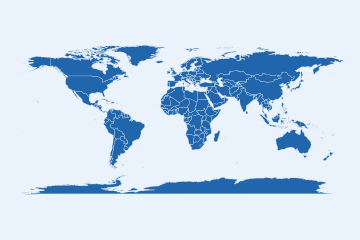
Auto-detects the country column, standardises it to ISO codes (via
standardize_country()), attaches geometry and returns a plot-ready frame –
the function that fulfils the package's promise for your own data. Pipe the
result straight into world_map().
Usage
join_world(
  data,
  country_col = NULL,
  origin = "country.name",
  geometry = c("polygon", "sf", "none"),
  scale = "small",
  region = NULL,
  projection = "equal_earth",
  recenter = NULL,
  warn = TRUE
)
Arguments
- data
A data frame keyed on country names or codes.
- country_col
The country column (unquoted). If omitted, it is auto-detected.
- origin
How to read
country_col(any countrycode origin scheme).- geometry
"polygon"(default),"sf"or"none".- scale
Natural Earth resolution for the
sfbackend."large"needs the non-CRANrnaturalearthhirespackage; seeworld_geometry().- region
Optional region subset (see
world_geometry()). Applied whichevergeometryis used, including"none"; with"none"there is nothing to clip, so a bounding box is refused rather than ignored.- projection, recenter
Projection, and optional central meridian, for the
sfbackend (seeworld_map()for the projections available).- warn
Whether to report unmatched countries (default
TRUE); also surfaces acheck_country_match()summary.
Value
A plot-ready frame: polygon tibble, sf object, or (for
geometry = "none") the standardised table.
Examples
rates <- data.frame(country = c("United States", "Brazil", "Kenya"),
                    vaccination_pct = c(0.7, 0.8, 0.6))
# \donttest{
joined <- join_world(rates, country)
# }