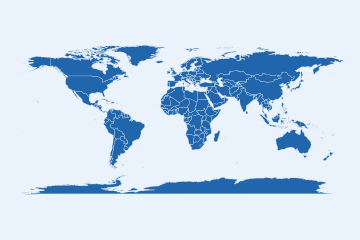
Point-in-polygon lookup: given longitude / latitude vectors (or an sf POINT
object), return the iso3c of the country each point falls in – the bridge
for getting point data (events, stations, observations) onto the country
spine so it can be joined, aggregated and mapped like everything else.
Usage
locate_country(
  lon = NULL,
  lat = NULL,
  points = NULL,
  scale = "small",
  add = "country",
  tolerance_km = 25
)
Arguments
- lon, lat
Equal-length numeric vectors of longitude / latitude, giving one point per element (ignored if
pointsis supplied). A point with a missing coordinate returnsNA, the same as a point in no country; a longitude outside[-180, 180]or a latitude outside[-90, 90]is an error rather than a silentNA, because it is a mistake and not an ocean.- points
Optional
sfPOINT object to use instead oflon/lat.- scale
Natural Earth resolution for the lookup geometry.
"large"needs the non-CRANrnaturalearthhirespackage; seeworld_geometry().- add
Extra attributes to return alongside
iso3c(anyconvert_country()destination, e.g."country","continent").- tolerance_km
Snap an unmatched point to the nearest country when it lies within this many kilometres of one (default
25). Coarse (110m) coastlines place some genuinely-onshore coastal points just outside their country (New York sits ~0.5 km beyond the simplified US coast); this rescues them while leaving open-ocean pointsNA(the nearest land is hundreds of km away). Set0for a strict point-in-polygon lookup.
Value
A tibble with one row per point: iso3c plus any add columns
(NA for points that fall in no country, e.g. open ocean).
Examples
# \donttest{
if (requireNamespace("sf", quietly = TRUE) &&
    requireNamespace("rnaturalearth", quietly = TRUE)) {
  locate_country(lon = c(2.35, -74.0), lat = c(48.85, 40.7))  # Paris, NYC
}
#> # A tibble: 2 × 2
#>   iso3c country
#>   <chr> <chr>
#> 1 FRA   France
#> 2 USA   United States
# }