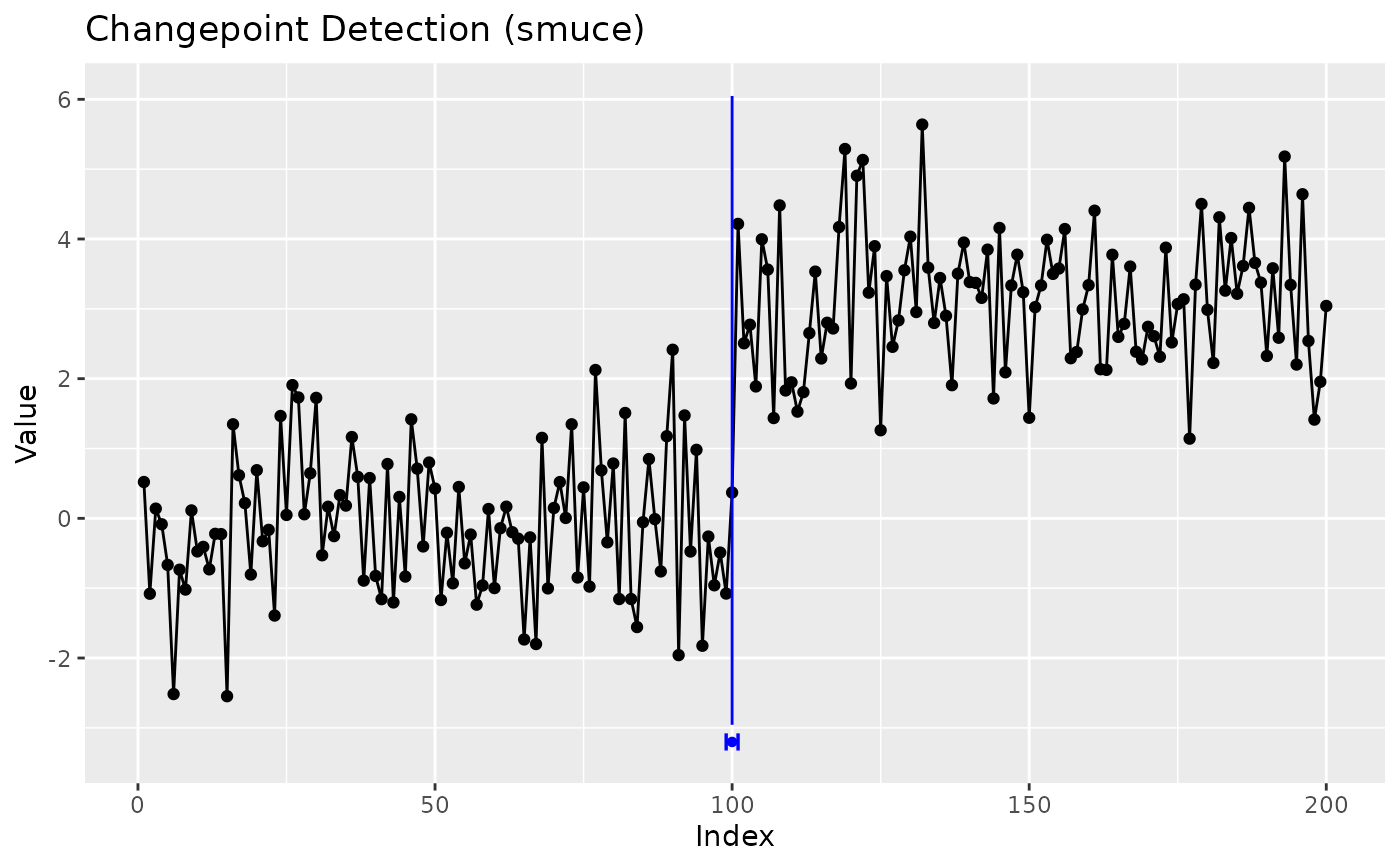
SMUCE / HSMUCE wrapper: multiscale changepoint inference
Source:R/wrap-inference.R
smuce_wrapper.RdWraps stepR::stepFit() for the Simultaneous MUltiscale Changepoint
Estimator (SMUCE) of Frick, Munk and Sieling (2014) and its heterogeneous
extension HSMUCE (Pein, Sieling and Munk, 2017). SMUCE estimates a step
function subject to a simultaneous multiscale test at level alpha;
the level bounds the probability of over-estimating the number of
changepoints, and the fit delivers confidence intervals for every
changepoint location, which populate the ci_lower/ci_upper
columns of the result and render via autoplot(show_ci = TRUE) or
geom_cpt_ci().
Usage
smuce_wrapper(
  x,
  alpha = 0.5,
  family = c("gauss", "hsmuce", "poisson", "binomial"),
  ...
)
Arguments
- x
A numeric vector.
- alpha
Significance level of the multiscale test in \((0, 1)\); smaller values yield more conservative (fewer-changepoint) fits. Defaults to
0.5, the upstream recommendation for estimation.- family
Noise model:
"gauss"(SMUCE, homogeneous Gaussian noise),"hsmuce"(HSMUCE, segment-wise variance),"poisson"(counts: a change in the rate) or"binomial"(0/1 outcomes: a change in the probability). Defaults to"gauss". The two count families runstepR::smuceR(), the multiscale estimator for exponential families, with the same level and the same jump intervals;cpt_detect(x, method = "smuce", family = "poisson")reaches them. stepR documentssmuceR()as deprecated but working, and as the only route to these families untilstepFit()gains them; should it be removed, the error says so and names the methods that fit the same family. Withalphagiven,smuceR()takes its threshold from the asymptotic null distribution rather than a simulated one. The remainingstepRfamilies ("jsmurf","mDependentPS", ...) all require a filter or covariance specification; callstepR::stepFit()directly for those."hsmuce"additionally refuses a series whose point-to-point variation lies more than about seven orders of magnitude below its own scale: a globally flat series, or a step whose segments are numerically constant, ascpt_simulate(sd = 0)produces once any rounding is added. stepR's heterogeneous variance estimator aborts the R session on such input rather than raising an error, so it cannot be caught."gauss"handles the whole range.- ...
Additional arguments passed to
stepR::stepFit()(stepR::smuceR()for the count families).
Value
A ggcpt object. The changepoints tibble carries
ci_lower/ci_upper (confidence interval for each
changepoint location) and the data tibble carries the SMUCE step
fit in its fitted column.
References
Frick K, Munk A, Sieling H (2014). “Multiscale change point inference.” Journal of the Royal Statistical Society: Series B, 76(3), 495–580.
Pein F, Sieling H, Munk A (2017). “Heterogeneous change point inference.” Journal of the Royal Statistical Society: Series B, 79(4), 1207–1227.
See also
Other changepoint engines:
bcp_wrapper(),
beast_wrapper(),
bfast_wrapper(),
binsegrcpp_wrapper(),
bocpd_wrapper(),
cpm_wrapper(),
cpop_wrapper(),
cpt_wrapper(),
decafs_wrapper(),
ecp_wrapper(),
envcpt_wrapper(),
esac_wrapper(),
fabisearch_wrapper(),
fastcpd_wrapper(),
fcov_wrapper(),
fmean_wrapper(),
fpop_wrapper(),
geomcp_wrapper(),
hdcov_wrapper(),
hdreg_wrapper(),
idetect_wrapper(),
inspect_wrapper(),
kcp_wrapper(),
kwc_wrapper(),
mcp_wrapper(),
mosum_wrapper(),
network_wrapper(),
not_wrapper(),
npmojo_wrapper(),
nsp_wrapper(),
ocd_wrapper(),
pilliat_wrapper(),
segmented_wrapper(),
sn_wrapper(),
strucchange_wrapper(),
taylor_wrapper(),
tguh_wrapper(),
trend_wrapper(),
var_wrapper(),
wbs2_wrapper(),
wbs_wrapper(),
wbsts_wrapper()