Runs one detector over every series in a collection: the panel-data loop
that methodological and applied work both need constantly. Accepts a
matrix/data frame (one column per series) or a named list of numeric
vectors. Honours future::plan() for parallel execution when the
future.apply package is available, with parallel-safe RNG.
Arguments
- x
For
cpt_batch(), a numeric matrix or data frame (columns are series) or a list of numeric vectors; for theprint()andtidy()methods, aggcpt_batchobject.- method
Detection method, passed to
cpt_detect().- change_in
What to detect change in, passed to
cpt_detect().- index
Optional time index shared by every series in the panel (a vector of dates, say), or a named list of one index per series. A list has to cover every series, with indices of one type, because
tidy()andautoplot()stack them into one table and one axis. Carried onto each result and used bytidy()andautoplot(), so a faceted plot of fifty series shows dates rather than positions.- seed
Optional seed for reproducible parallel execution (passed to
future.apply::future_lapply()asfuture.seed; applied viaset.seed()when running sequentially). The seed is scoped to this call:.Random.seedis saved and restored, so a seeded call inside a simulation loop does not pin the loop's own stream.- keep_fit
Keep each engine's raw fit in
result[[i]]$fit? Defaults toTRUE, which is what makes a batch result as inspectable as a single one. Set it toFALSEfor a large panel: a few engines return fits far bigger than the data they were given.strucchangekeeps a triangular \(O(n^2)\) RSS matrix, so a single 2000-point series costs about 135 MB, andbfastandbocpdare in the tens of MB, and a panel multiplies that by the number of series. Everything else on the object, includingtidy()andautoplot(), is unaffected; only accessors that read$fit(cpt_statistic(),ggcpt_posterior(),cpt_confint(engine = \"native\")) need it.- ...
Additional arguments passed to every
cpt_detect()call.- object
A
ggcpt_batchobject (forautoplot()).
Value
A ggcpt_batch object: a tibble with one row per series and
columns series, n_changepoints, changepoints (a
list-column of tidy tibbles), and result (a list-column of
ggcpt objects). Methods: print(), tidy() (one row
per changepoint across all series, with columns series,
cp and cp_value), and autoplot() (faceted
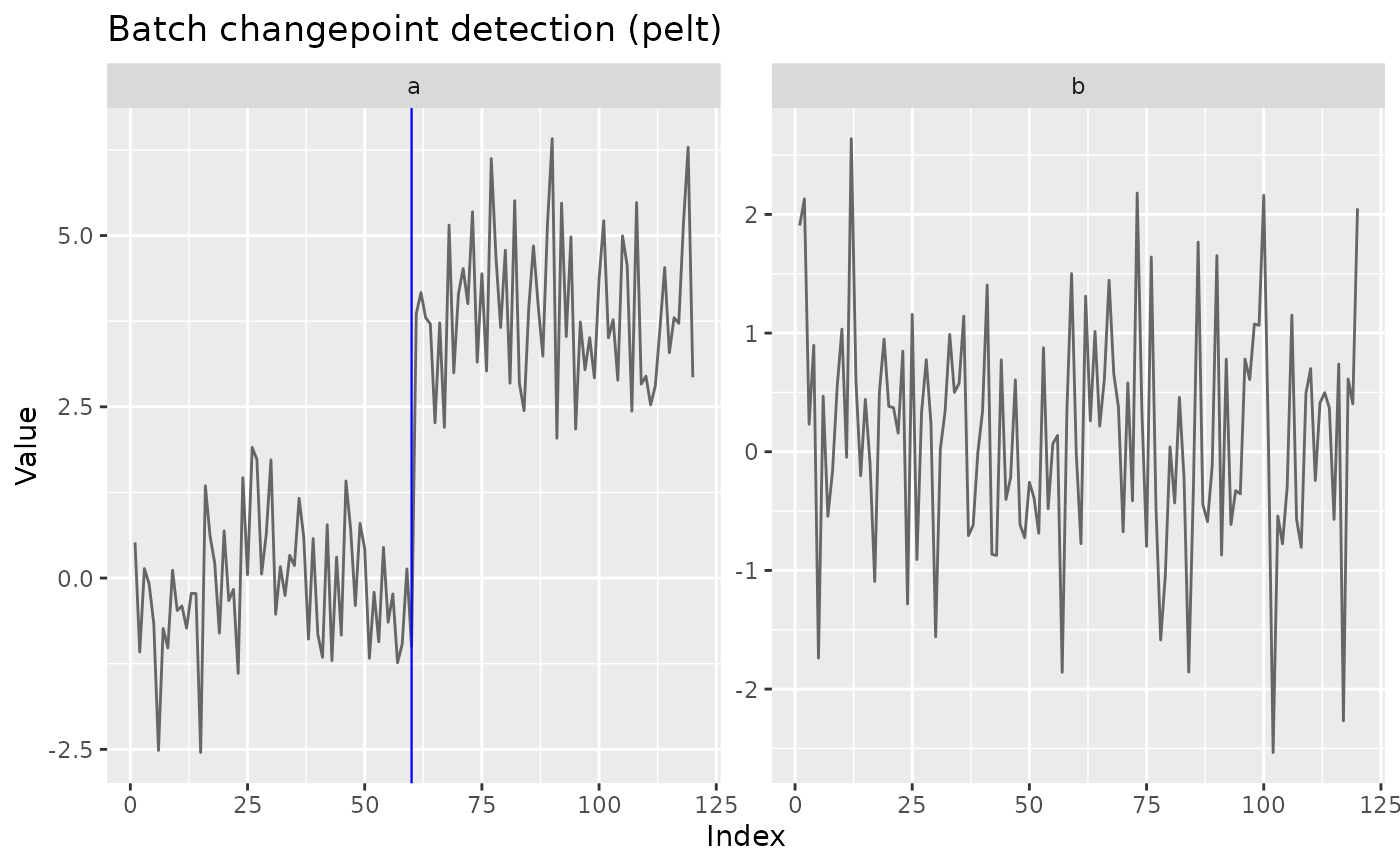
small-multiples with each series' changepoints).
Examples
set.seed(2026)
X <- cbind(a = c(rnorm(60), rnorm(60, 4)), b = rnorm(120))
batch <- cpt_batch(X, method = "pelt")
batch
#> ggcpt_batch (2 series, method: pelt)
#>
#> # A tibble: 2 × 2
#>   series n_changepoints
#>   <chr>           <int>
#> 1 a                   1
#> 2 b                   0
tidy(batch)
#> # A tibble: 1 × 3
#>   series    cp cp_value
#>   <chr>  <int>    <dbl>
#> 1 a         60   -0.999
ggplot2::autoplot(batch)