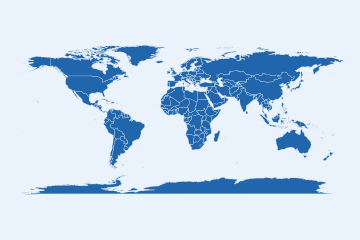
Sometimes you just want the canvas: country polygons, label-ready centroids, coastlines, internal borders, a graticule or an ocean rectangle – already projected, region-subset and antimeridian-safe. This is the building block the plotting functions sit on, exposed for power users.
Arguments
- what
What to return:
"countries"(default),"centroids","coastline","borders","graticule"or"ocean".- geometry
"polygon"(a tibble oflong/lat/group: the bundled Natural Earth 1:50m countries, which need no extra package) or"sf"."maps"draws the polygon backend from themapspackage as releases before 4.0.0 did; it is deprecated.- scale
Natural Earth resolution for the
sfbackend:"small"(110m),"medium"(50m) or"large"(10m). The polygon backend draws its one bundled resolution, 1:50m, and warns if asked for"large"."large"additionally needs thernaturalearthhirespackage, which is not on CRAN (install.packages("rnaturalearthhires", repos ="https://ropensci.r-universe.dev"));"small"and"medium"need nothing beyondrnaturalearthdata. Coarser scales carry fewer countries as well as less detail – seeattach_geometry().- region
Optional subset: a continent, a group name, a vector of
iso3ccodes, or a bounding boxc(xmin, ymin, xmax, ymax). A box is the one form that clips the shapes themselves rather than selecting whole countries – properly, viasf::st_crop(), on thesfbackend. The polygon backend can only drop the vertices outside the box, which leaves a country straddling the edge with an approximate outline, so it warns.- projection
Projection for the
sfbackend (seeworld_map()). The polygon backend returns longitude/latitude, which the map verbs project when they draw, and warns if asked to project here.- recenter
Optional central meridian (e.g.
150). On the polygon backend every ring is cut at the new antimeridian and shifted, so the longitudes run fromrecenter - 180torecenter + 180.- year
Draw the world as it was in this year, via
historical_geometry()and CShapes (1886-2019). Returnssfkeyed ongwcode; onlywhat = "countries"is available, andregioncannot be combined with it.- worldview
Draw the boundaries as one country's government draws them: the viewing country's ISO alpha-3 code (
"IND","CHN", ...) or"ISO", for one of the 31 points of view Natural Earth publishes. Needsgeometry = "sf"; the file is Natural Earth's 1:10m, downloaded once (about 5 MB) into the package's cache.NULL(default) is the worldview set withdispute_policy(), if any, and otherwise Natural Earth's own de facto boundaries. The package takes no position: you choose, andmap_provenance()records the choice.
Value
A tibble (polygon backend) or sf object (sf backend), with columns
depending on what:
"countries"polygon:
long,lat,group,order,region,subregion,iso3c,iso2c. sf:iso3c,iso2c,name_long."centroids"the same identifier columns plus
centroid_lonandcentroid_lat."coastline","borders","ocean","graticule"sf only.
The centroid columns are in the coordinate system of the object
returned, so on the sf backend they are projected metres, not degrees –
centroid_lon for France is 174097, not 2.1. For centroids in degrees
use country_meta$centroid_lon / $centroid_lat, which is also what the
polygon backend returns.
A few Natural Earth features have no ISO code and so come back with iso3c
NA – Somaliland at every scale, plus the Indian Ocean Territories and
Ashmore and Cartier Islands from "medium" on. They are kept so the land is
still drawn; drop or country_overrides() them if you group by iso3c.
"orthographic" is the one genuinely hemispheric projection: the countries
on the far side have no image and come back as empty geometries, and the
ones on the horizon are cut there (correctly, but sf::st_coordinates()
cannot read a column that mixes empty and non-empty – drop them first).
The other three azimuthal projections
("azimuthal_equal_area", "north_polar", "south_polar") are Lambert
equal-area and draw the whole globe, the far side stretched around the
rim rather than dropped, so pass region if you want a polar view of the
northern countries alone. "north_polar" leaves out what lies wholly
south of 60 degrees S (Antarctica), whose pole is its antipode: an empty
geometry on the sf backend, no rows on the polygon backend.
"ocean" is a whole-globe background rectangle. It is unavailable in all
four azimuthal projections – "orthographic" has no image for it, and the
Lambert three cut the globe at the antipode, which collapses the rectangle's
outline – and it cannot be recentred; both cases error rather than
returning an invisible layer.
Examples
# \donttest{
head(world_geometry("countries", geometry = "polygon"))
#> # A tibble: 6 × 8
#>    long   lat group order region subregion iso3c iso2c
#>   <dbl> <dbl> <int> <int> <chr>  <chr>     <chr> <chr>
#> 1  131.  42.3     1     1 Russia NA        RUS   RU
#> 2  131.  42.3     1     2 Russia NA        RUS   RU
#> 3  131.  42.4     1     3 Russia NA        RUS   RU
#> 4  131.  42.4     1     4 Russia NA        RUS   RU
#> 5  131.  42.5     1     5 Russia NA        RUS   RU
#> 6  131.  42.5     1     6 Russia NA        RUS   RU
# }