One row per country with the facts people constantly need and currently scrape together by hand.
Format
A tibble with one row per country and columns iso3c, iso2c,
country, continent, region, un_region, income, capital,
capital_lat, capital_lon, centroid_lat, centroid_lon, area_km2,
currency, tld, landlocked, flag.
Assembled from countrycode::codelist, plus a curated row for Kosovo
(XKX), which countrycode does not carry, so distance_between() and
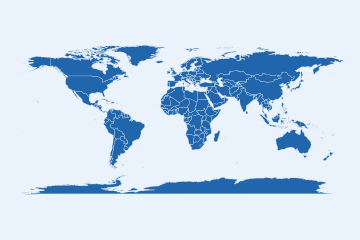
the k-nearest-neighbour weights can use it. Centroids and areas come
from the bundled Natural Earth 1:50m polygons, the ones the polygon
backend draws, with each country's holes taken out; territories drawn as
part of their country (French Guiana, Svalbard) take theirs from Natural
Earth's map units. Three territories have a row but no centroid or area,
because Natural Earth does not draw them at 1:50m: Bouvet Island,
Gibraltar and the U.S. Minor Outlying Islands.
income and region are the World Bank's for the current fiscal year
(the "classification" attribute names it, "FY2027"), from
country_classifications, so they agree with what world_data()
returns; region falls back to countrycode's where the World Bank
lists no region.
country therefore carries the English names from countrycode
("South Korea", "Congo - Kinshasa"), which differ from the World Bank's for
39 of the 216 countries in world_snapshot ("Korea, Rep.",
"Congo, Dem. Rep."). Each
table is faithful to its own source, so join on iso3c and keep whichever
label you want to display – reconciling the two is what country_join()
is for.