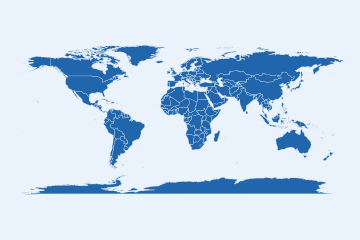
A small, lazy-loaded, one-row-per-country snapshot of a curated indicator set for one recent year. It lets every example, test and vignette run offline and deterministically, without the World Bank API.
Format
A list with three elements:
- countries
A tibble, one row per country, with
iso3c,iso2c,country, the classificationscontinent,regionandincome, and the curated indicatorsgdp_per_capita,population,life_expectancyandco2_per_capita.- sf
NULLin the released package – geometry is not bundled twice. Attach it on demand withattach_geometry():attach_geometry(world_snapshot$countries, geometry = "sf")pulls the same Natural Earth 110m polygons fromrnaturalearth.- year
The reference year.
country carries the World Bank's own names, which differ from the
countrycode names used by country_meta for 39 countries.
income and region are the World Bank's classifications in force on
1 January of the snapshot year (fiscal year 2024), from
country_classifications: the regions are therefore the ones before the
July 2025 change, with Afghanistan and Pakistan in South Asia. Data
fetched with world_data() carries the current fiscal year's instead, and
source_info() says which each frame holds.
The "provenance" attribute records the World Development Indicators
release the values come from, the build date, the package versions used,
and why the snapshot is on its year: it moves to a newer year only when
every indicator's coverage there is within five percentage points of the
current year's. The indicator columns carry a source_info() record.