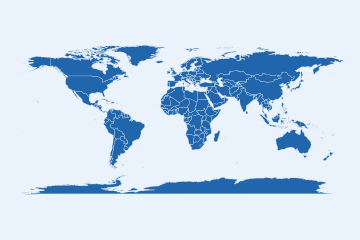
A ggplot2 layer that places labels (names, ISO codes or flag emoji) at
country centroids, with optional ggrepel collision avoidance. Designed for
the polygon backend produced by world_data() / join_world(): it reads the
long, lat and group columns, so it errors on an sf frame and points at
ggplot2::geom_sf_text() instead. Placement is exact only while group is
present – that is what identifies each country's separate pieces, and the
label goes on the largest one.
Arguments
- mapping
Aesthetic mapping; defaults to
aes(label = iso3c).- data
Optional layer data, as for any
ggplot2geom: a frame (label only those countries – the usual way to label a handful rather than all two hundred), or a function of the plot's data. Whatever you pass is reduced to one centroid per country before it is drawn. Defaults to the plot's own data.- repel
Use
ggrepelto avoid overlaps (defaultTRUE). Falls back to plain labels, with a one-time note, whenggrepelis not installed.- flag
If
TRUE, label with flag emoji instead of the mapped label.- size
Label text size.
- ...
Passed to the underlying text geom.
Examples
# \donttest{
library(ggplot2)
snap <- countryatlas::world_snapshot$countries
mapdf <- attach_geometry(snap, geometry = "polygon")
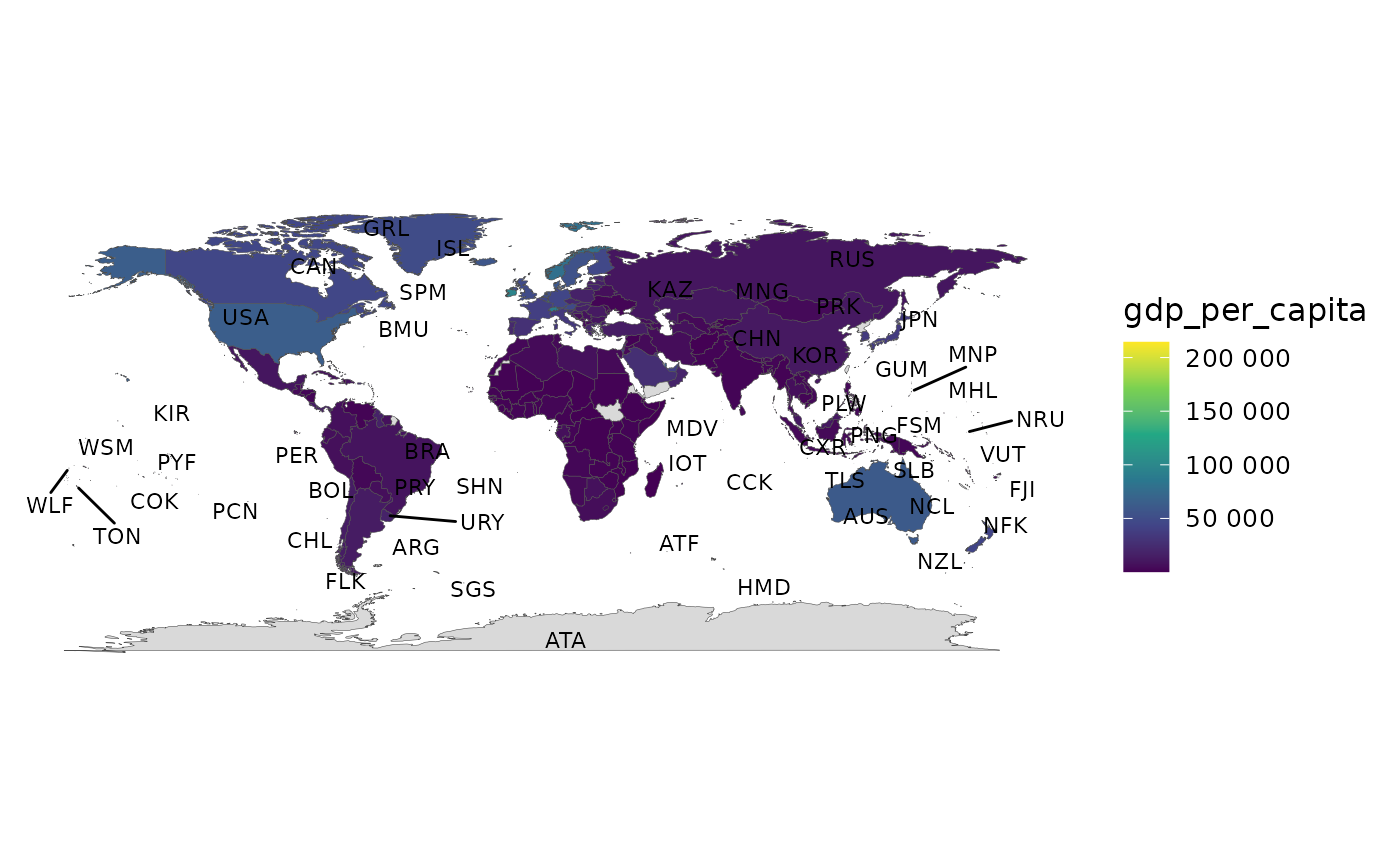
# Labelling all 188 countries at once is unreadable, and ggrepel responds
# by dropping nearly every label. Pass `data` to choose a subset ...
world_map(mapdf, gdp_per_capita) +
geom_country_labels(
data = ~ dplyr::filter(.x, iso3c %in% c("USA", "BRA", "CHN", "IND", "ZAF"))
)
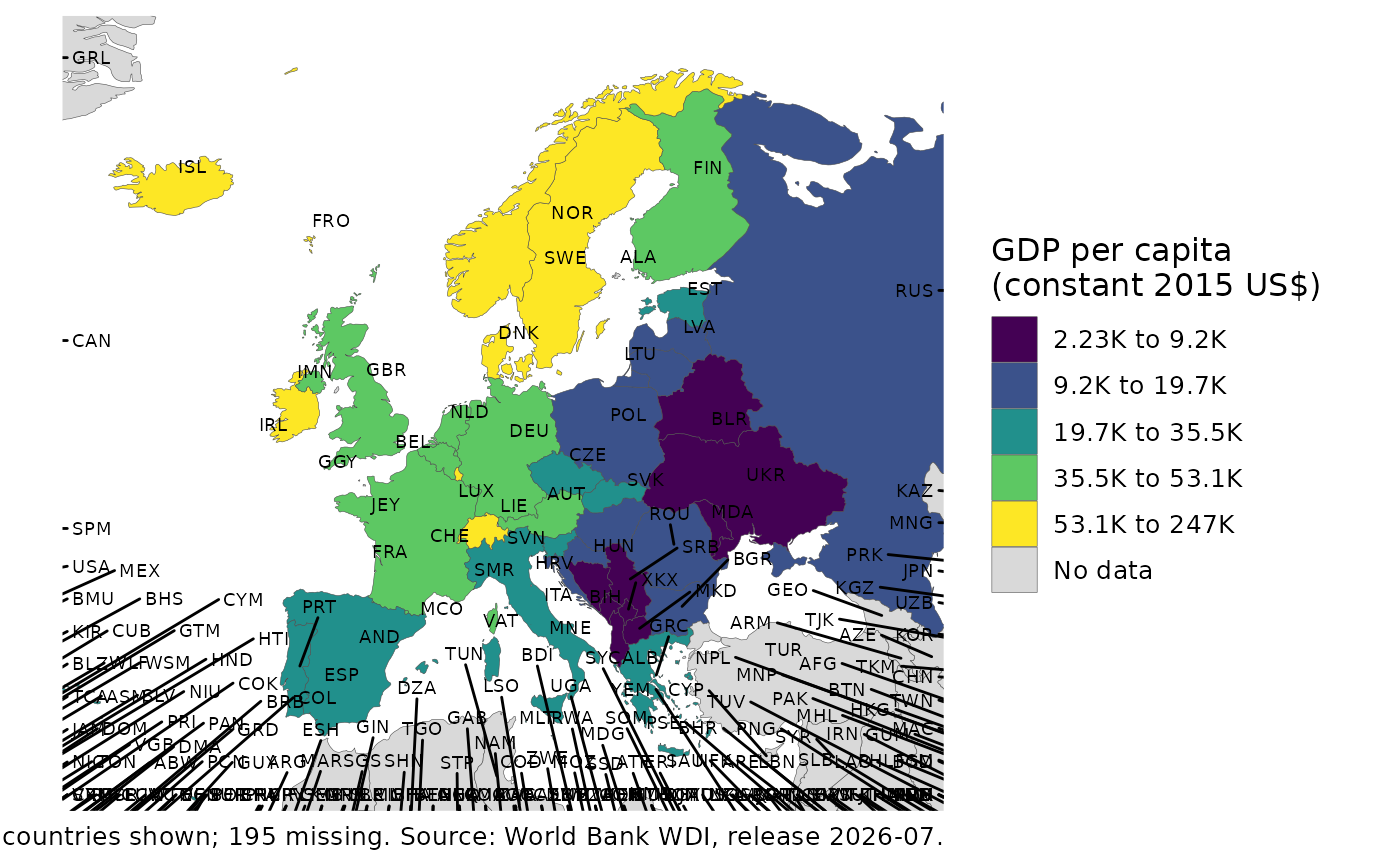
 # ... or zoom in, where there is room for every label.
europe <- attach_geometry(
dplyr::filter(snap, continent == "Europe"), geometry = "polygon")
world_map(europe, gdp_per_capita) +
geom_country_labels(size = 2.5) +
coord_quickmap(xlim = c(-25, 45), ylim = c(34, 72))
#> Coordinate system already present.
#> ℹ Adding new coordinate system, which will replace the existing one.
# ... or zoom in, where there is room for every label.
europe <- attach_geometry(
dplyr::filter(snap, continent == "Europe"), geometry = "polygon")
world_map(europe, gdp_per_capita) +
geom_country_labels(size = 2.5) +
coord_quickmap(xlim = c(-25, 45), ylim = c(34, 72))
#> Coordinate system already present.
#> ℹ Adding new coordinate system, which will replace the existing one.
 # }
# }