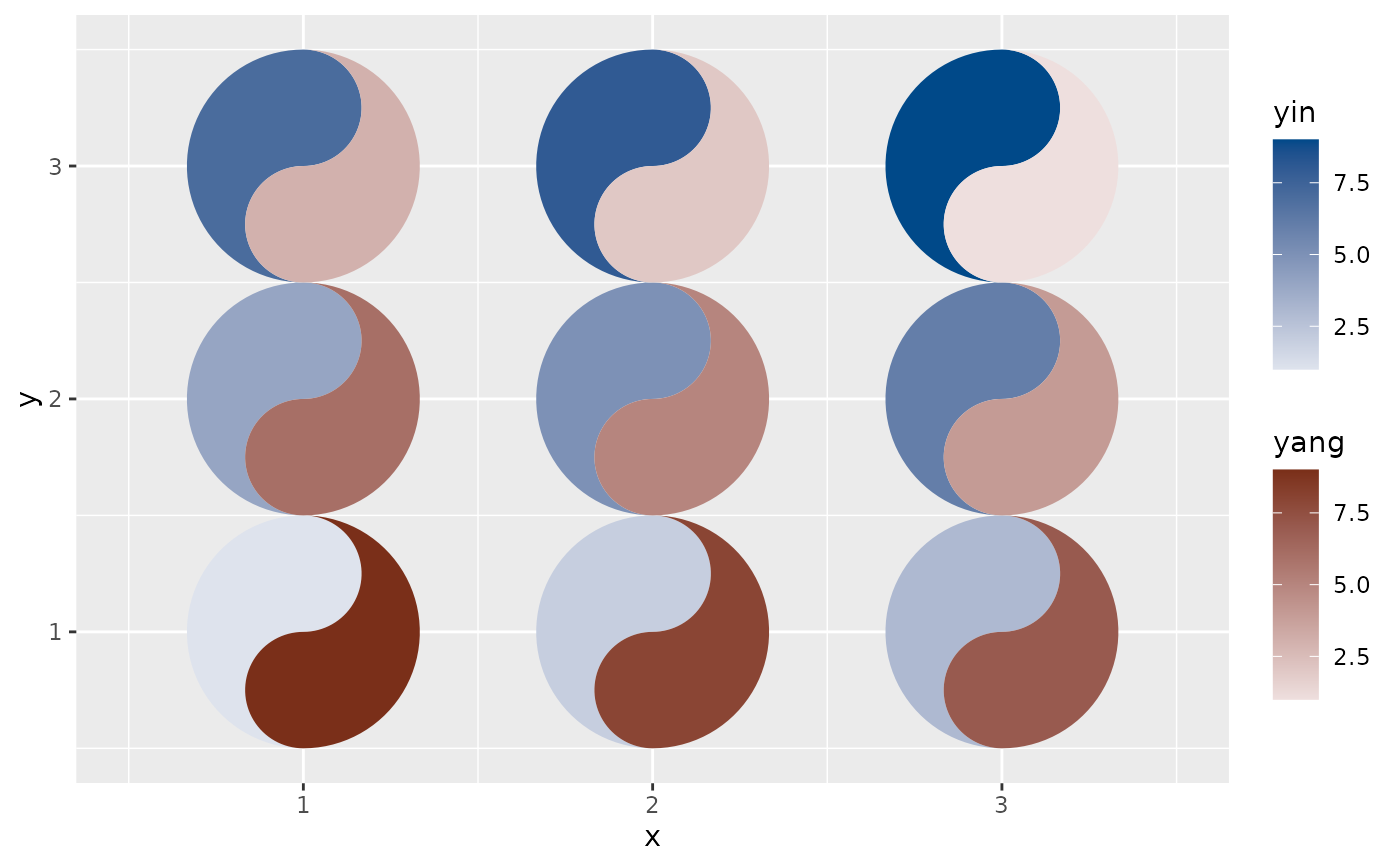
The two fish of a taichi symbol are compared against each other, so the
two fill ramps have to be matched: if one ramp spans a wider luminance
range than the other, equal values do not produce equal visual weight and
one fish systematically appears to dominate. That makes palette pairing a
correctness problem rather than a matter of taste: see
taichi_check_palette() for the measurement and vignette("ggtaichi")
for the discussion.
Arguments
- n
Number of colours per ramp. The default, 5, matches the length of the built-in
yin_colors/yang_colorsvectors.- hues
Two hues in degrees,
c(yin, yang), on the HCL colour wheel (0 red, 120 green, 250 blue). Pick hues far apart; opposite hues (a difference near 180) are the most distinguishable.- luminance
The two ends of the shared luminance trajectory as
c(dark, light), on the CIE L\* scale from 0 (black) to 100 (white). Both ramps run from the light end to the dark end, so the first colour belongs to the lowest value, the same convention asyin_colors/yang_colors.- chroma
Chroma (colourfulness) at the dark end of each ramp. Chroma tapers towards the light end, because a very light colour cannot also be saturated; both ramps taper identically. Values above about 80 will be clipped to the sRGB gamut, and clipping is hue-dependent, which is exactly what breaks the match. Keep it moderate and verify with
taichi_check_palette().
Value
A list of two character vectors of hex colours, yin and yang,
each of length n. Pass them straight to geom_taichi() as
yin_colors / yang_colors, or hand the whole list to its palette
argument.
Details
taichi_palette_pair() constructs two sequential ramps in the perceptual
HCL space that differ only in hue: they share one luminance trajectory
and one chroma trajectory, so step i of the yin ramp and step i of the
yang ramp carry the same visual weight.
See also
taichi_check_palette() to measure any pair,
taichi_palette() for the ready-made presets.
Examples
pair <- taichi_palette_pair()
pair
#> $yin
#> [1] "#DEE3ED" "#AEB9D1" "#7D91B6" "#4A6C9D" "#004989"
#>
#> $yang
#> [1] "#EEDFDE" "#D2B1AD" "#B6857E" "#985A4F" "#7A2F19"
#>

# the pair is matched by construction; the package defaults are not
taichi_check_palette(pair$yin, pair$yang)
#> <ggtaichi palette check>
#>
#>   step yin            L      C   yang           L      C       dL
#>   1    #DEE3EC     90.1    5.0   #EDDFDE     89.9    5.1      0.2
#>   2    #C5CDDE     82.3    9.4   #E0C7C5     82.2    9.4      0.0
#>   3    #ADB8D1     74.7   13.9   #D2B1AC     74.9   13.1     -0.2
#>   4    #95A4C3     67.2   17.7   #C49A95     67.3   17.2     -0.1
#>   5    #7D91B6     59.9   21.7   #B6857E     60.1   21.0     -0.2
#>   6    #647EA9     52.4   25.9   #A76F66     52.4   25.4     -0.1
#>   7    #4A6C9D     45.1   30.4   #98594E     44.8   30.3      0.3
#>   8    #2F5A93     37.9   36.1   #894433     37.3   36.5      0.6
#>   9    #004888     30.4   41.6   #792E19     29.6   43.2      0.8
#>
#>   largest luminance mismatch : 0.8 L* (tolerance 5.0)
#>   largest chroma mismatch    : 1.5
#>   measured in                : CIE Lab (L*, C*ab), CIE2000 distances
#>   how far apart the ramps stay (median distance, step for step)
#>       normal       26.4
#>       deutan       27.7
#>       protan       22.9
#>       tritan       40.3
#>
#>   Verdict: PASS
#>   the two ramps share a luminance trajectory, so equal values
#>   read as equal ink.

library(ggplot2)
d <- data.frame(x = rep(1:3, 3), y = rep(1:3, each = 3),
                yin = 1:9, yang = 9:1)
ggplot(d, aes(x, y)) +
  geom_taichi(yin = yin, yang = yang, palette = pair, shared_limits = TRUE)